

Publishing a blog post and watching it climb Google’s search results can be exciting. But what happens a few months later?
Sometimes, traffic slowly drops.
A page that once brought in hundreds or thousands of visitors may start getting fewer clicks. Rankings slip from page one to page two. Impressions decline. The content may still be useful, but it is no longer performing as well as it once did.
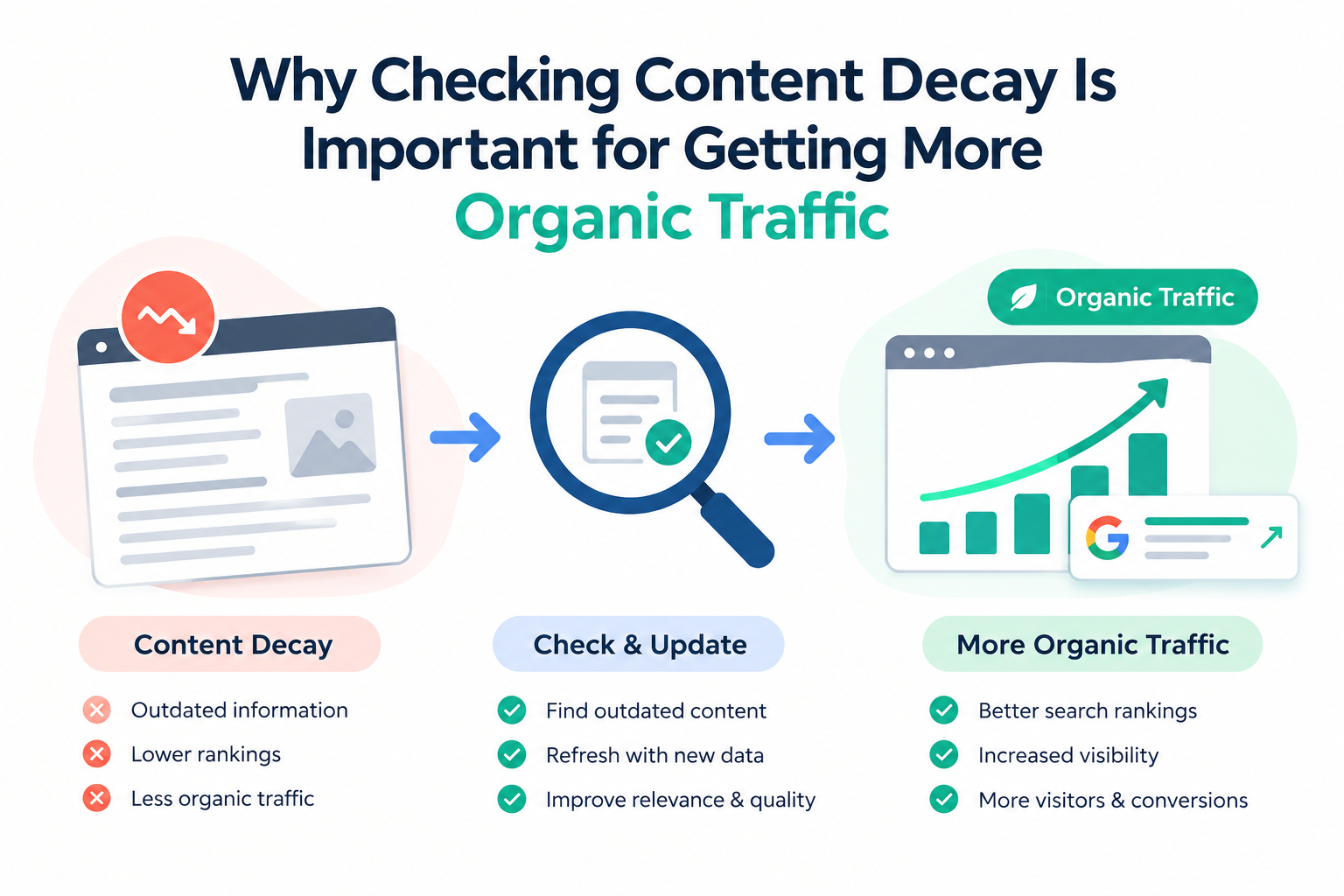
This is known as content decay.
Content decay is a normal part of SEO. Search results change, competitors publish better pages, search intent evolves, and information becomes outdated. If you ignore those changes, you can lose organic traffic without realizing where it went.
The good news is that declining content can often be improved.
By regularly checking your existing content, finding pages that are losing performance, and updating them at the right time, you can recover traffic without constantly creating new articles.
What Is Content Decay?
Content decay happens when a page gradually loses organic search performance after previously performing well.
For example, imagine you published an article about the best project management tools. Six months later, it ranks in the top five for several valuable keywords.
Then things start changing.
New software products enter the market. Competitors update their articles. Some of your recommendations become outdated. Google sees newer pages that better satisfy the searcher's needs.
Your article moves from position 3 to position 7.
You might not notice immediately. But over several months, those ranking changes can result in a significant drop in organic traffic.
That's content decay.
It doesn't necessarily mean the article is bad. It means the page may no longer be as competitive or relevant as it once was.
Why Content Decay Matters for SEO
Creating new content is only one part of a successful SEO strategy.
The content you've already published is an asset. Some of those pages may already have backlinks, search visibility, topical authority, and a history of bringing visitors to your website.
Letting those pages decline means leaving potential traffic on the table.
Regular content maintenance helps you get more value from the work you've already done.
1. Your Rankings Can Change Over Time
Search rankings aren't permanent.
A page ranking #2 today might be #8 several months from now. Competitors continuously publish and update content, and Google's understanding of search queries continues to evolve.
Even if you haven't changed your page, the search results around it may have changed.
That's why monitoring your rankings is important.
A gradual decline can be an early warning that a page needs attention.
2. Search Intent Can Change
What people expect from a search query can change over time.
Consider a keyword such as "best SEO tools."
A few years ago, a simple list of popular tools might have been enough. Today, searchers may expect pricing information, comparisons, screenshots, use cases, integrations, and current alternatives.
If your article still answers yesterday's version of the query, it may struggle to compete with pages that better match today's expectations.
Updating content isn't just about changing the publication date. It's about making sure the page still answers the question people are actually asking.
3. Outdated Information Can Cost You Traffic
Some topics become outdated quickly.
Prices change. Products are discontinued. Features are added. Statistics become old. Companies rebrand. Search engine guidelines evolve.
An article containing outdated information can lose both rankings and credibility.
For example, an article recommending a software product that shut down two years ago isn't going to provide much value to readers.
Keeping important pages current gives search engines and visitors a reason to trust your content.
How to Find Content That Is Decaying
You don't need to update every article on your website every month.
Instead, look for pages showing signs of declining performance.
Some useful signals include:
Organic traffic has steadily decreased.
Important keyword rankings have dropped.
Search impressions are declining.
Click-through rate has fallen.
Competitors now provide more comprehensive information.
The content contains outdated statistics or examples.
The page no longer matches current search intent.
The article hasn't been updated in a long time.
The key word here is declining.
A page receiving less traffic because the topic is seasonal isn't necessarily experiencing content decay. You want to identify a sustained decline rather than a temporary fluctuation.
Don't Wait Until Traffic Disappears
One of the biggest mistakes is waiting until a page has lost most of its traffic before updating it.
By then, recovering the original rankings may take considerably more work.
It's often better to treat declining performance as an early warning.
For example:
Healthy page:
Position 4 → Position 4 → Position 5
Potential decay:
Position 3 → Position 5 → Position 8 → Position 11
The second pattern deserves investigation.
A small ranking decline doesn't automatically mean you need to rewrite the entire article. But it does give you a reason to look at what changed.
What Should You Do When Content Starts to Decay?
Once you've identified a declining page, compare it with the pages currently ranking above you.
Look for meaningful differences.
Ask yourself:
Does the competing page answer the search query more completely?
Is its information more current?
Does it cover questions your article doesn't?
Is the structure easier to navigate?
Does it provide better examples?
Are important sections missing?
Has the search intent changed?
Does your title accurately describe what the reader will find?
Then improve your page based on what you discover.
Update outdated information
Replace old statistics, screenshots, examples, prices, product information, and references.
Fill content gaps
If competing pages answer important questions that your article ignores, consider adding useful sections.
Don't add paragraphs simply to make the article longer. Add information because it helps the reader.
Improve the introduction
The introduction should quickly explain what the reader will learn and why the information is useful.
A long introduction that takes several paragraphs to reach the point can make an otherwise good article harder to use.
Review your title and headings
Your title should clearly communicate the value of the page.
Headings should make the article easy to scan and help readers find the information they need.
Strengthen internal links
Link relevant pages together.
If you have a detailed article about keyword research, for example, it may make sense to link to it from an article about improving organic traffic.
Internal links help visitors discover related information and help search engines understand relationships between pages on your website.
Content Decay Doesn't Mean You Need to Rewrite Everything
This is an important distinction.
Not every declining page needs a complete rewrite.
Sometimes a page only needs:
Updated statistics
A few new sections
Better internal links
Updated examples
Improved headings
A stronger introduction
More accurate information
Better alignment with search intent
A targeted update can be more effective than starting from scratch.
Your existing page may already have backlinks, authority, and ranking history. Preserving those advantages while improving the content can make sense.
How Often Should You Check for Content Decay?
There isn't one perfect schedule for every website.
A site publishing news or rapidly changing information may need frequent checks. A small business website with evergreen content may only need a monthly or quarterly review.
A practical approach is to monitor important pages regularly and review declining pages before they become major traffic losses.
Start with your most valuable content.
Look at pages that:
Generate significant organic traffic.
Rank for commercially valuable keywords.
Have strong backlinks.
Generate leads or sales.
Previously performed well but are now declining.
You don't need to monitor hundreds of pages manually from day one.
Start with the pages that matter most to your business.
Content Refreshing Can Be More Efficient Than Constant Publishing
There's a common assumption in SEO that more content always means more traffic.
Not necessarily.
Publishing another article while existing high-value pages are losing traffic can create an unnecessary content treadmill.
Instead, consider balancing content creation with content maintenance.
Create new content when there are valuable topics you haven't covered.
Refresh existing content when an established page has started losing its competitive edge.
This approach can make your SEO strategy more sustainable.
A Simple Content Decay Workflow
You can make content decay monitoring part of your regular SEO process.
Step 1: Identify important pages
Find your pages that generate the most organic traffic or business value.
Step 2: Monitor performance
Track rankings, impressions, clicks, and organic traffic over time.
Step 3: Look for sustained declines
Don't react to every small ranking fluctuation. Look for meaningful downward trends.
Step 4: Investigate the cause
Check competitors, search intent, content freshness, keyword rankings, and technical issues.
Step 5: Refresh the page
Update information and improve the areas that are no longer competitive.
Step 6: Monitor the result
After making changes, continue tracking the page to see whether performance improves.
This turns content updating from guesswork into a repeatable SEO process.
Final Thoughts
Content decay is one of the easiest SEO problems to overlook because nothing necessarily breaks.
Your website stays online. The article still loads. The links still work.
But gradually, rankings can fall and organic traffic can disappear.
That's why monitoring your existing content matters.
Instead of constantly asking, "What should we publish next?", ask another important question:
"Which pages that used to perform well are starting to decline?"
Finding those pages early gives you an opportunity to update them before a small ranking drop becomes a major traffic loss.
For many websites, the fastest SEO opportunity isn't always creating something new. Sometimes, it's improving what already works.